August 20, 2026 Janine Praxmarer
In the first part, I wrote about the possibilities that artificial intelligence offers in recruiting – and why I prefer to use it rather than traditional methods. Support because I see it as a threat. But the more I deal with it, the more another question arises: How much automation is actually useful?
Because just because something is technically possible, that doesn’t automatically mean we should completely automate it. I find this question particularly important, especially when it comes to recruiting.
Efficiency is not everything
Companies understandably want to work efficiently. When an open position needs to be filled, it should happen as quickly as possible. Applications should be processed quickly and suitable candidates should be found easily. That is understandable.
But I believe that recruiting should not be judged solely by speed. What good does it do a company if a position is filled extremely quickly, but the person leaves after a short time because it simply didn’t fit? Then the process may have been quick, but not necessarily successful.
Not only: „How quickly can we find someone?“ – but above all: „Can we find the right person?“
And between these two questions lies a big difference.
How does an automated application process feel like?
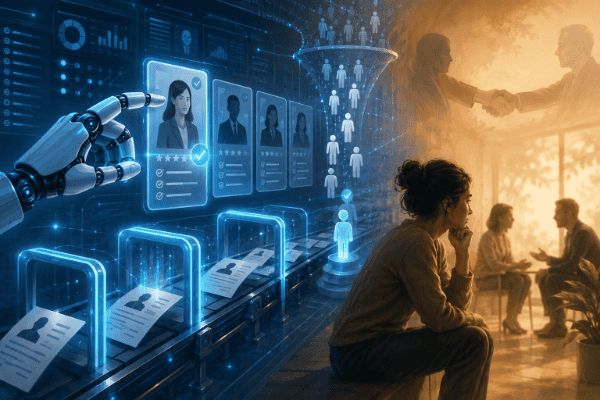
I find it interesting to take the applicant’s perspective for a moment. Imagine you are applying for a job at a company. You submit your documents and immediately receive an automatic confirmation of receipt. After that, your application is analyzed by a system. Perhaps an AI answers your questions. Perhaps even a first interview is conducted automatically.
Everything works quickly. Everything is digital. Everything is efficient. But how does that feel for the applicant? Does one have the feeling that someone is really working on their own application – or does it eventually feel like you are just another number in a system?
„Behind every application is a person – with a professional future at stake.“
Perhaps this person has been looking for a job for weeks or months already. Perhaps he/she has lost their previous job. Perhaps they want to change careers or are looking for a better way to combine family and work. For the applicant, therefore, applying is not just a simple process.
Applicants are also using AI
Interestingly, AI is not only available to companies; applicants can also use it. A resume can be optimized, a cover letter created, and interview questions practiced with AI. This is initially a good way to prepare better.
But this also changes the application itself. As more and more applicants use AI to make their documents look as professional as possible, applications may eventually become increasingly similar. And then the question arises again: How do we actually find out who is behind these perfect application documents?
For me, this does not make the personal conversation any less important, but perhaps even more important.
What a conversation can achieve, what a CV cannot
When I talk to a candidate, I get a completely different impression. I hear how someone communicates. I can ask questions. I can dig deeper. I can understand why someone chose a particular career path. And sometimes I learn things that are not even mentioned in the resume.
- Perhaps someone took a career break because they needed to reorient themselves.
- Perhaps someone deliberately chose a different direction.
- Perhaps there is a certain qualification lacking, but the person is willing to catch up on it.
- Perhaps an experience on the resume seems unimportant at first – but turns out to be a great advantage in the interview.
It’s exactly these kinds of things that make recruiting interesting for me.
What happens when an AI misapplies a judgment to a human being?
Another point I think about when it comes to this topic is responsibility. When an AI analyzes applications and sorts out certain candidates, the question eventually arises: Who actually decides about a person’s professional future?
Of course, no one will seriously claim that an AI intentionally wants to „reject“ someone. But systems work based on data and specific criteria. And that is precisely why there is a risk that a candidate who does not fit the expected pattern will not even be considered at all. In fact, this very candidate could be interesting.
- Maybe he's a recent graduate.
- Perhaps someone with an unusual background.
- Maybe someone who doesn't meet all the requirements, but is very motivated.
- Perhaps someone with ten years of experience in a field that does not exactly match the job description, but would be well transferable.
Therefore, I would never completely automate decisions about people. AI can support them, but in my opinion, a human should always be involved in the end.
Personal contact may even become more important
This may at first sound somewhat contradictory: the more we automate, the more important personal contact could become. Because as more and more communication takes place automatically, a real conversation may once again become something special.
A candidate notices the difference when they don’t just receive an automated message, but actually reach someone who knows their application and has been involved with it. Companies can also benefit from this: recruiting is not just a service for the company; it is also part of its external image. How a company deals with applicants says a lot about the company culture.
AI and humans do not have to be adversaries
Therefore, I do not see this development as a battle between man and machine. I believe that it is rather about combining the strengths of both sides.
- AI is fast.
- AI can process large amounts of information.
- AI can help with routine tasks.
- The human being can listen, ask questions, understand relationships, and assess situations individually.
Why shouldn't we combine these strengths? That would be the most sensible way for me.
I believe that automation in recruiting can bring many benefits. But it should not become an end in itself. Just because we can automate a process, it doesn’t mean we have to completely automate it. For me, technology should support people and not replace them in recruiting. Because when it comes to people’s professional future, I still find personal contact very important.
If AI can take on more and more tasks – what exactly is it still good for? a good recruiter That's what the third and final part is about.