October 15, 2026 Heinz W. Süess
When discussions of high sick leave rates are held, the focus is often on cold waves, staff shortages, and rising costs. However, a significant portion of the longer absences are due to mental illnesses.
In the first half of 2026, they were the most common cause of absences among DAK-insured employees in Germany. (DAK-Gesundheit, 2026b).
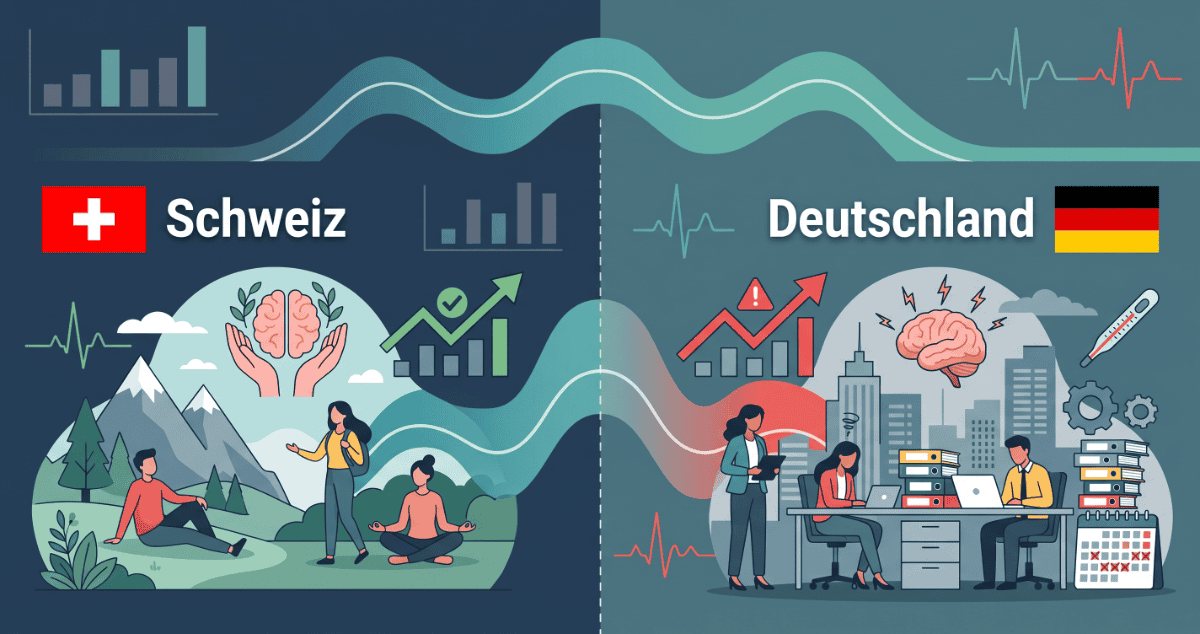
And Switzerland? Is the working environment here more psychologically healthy – Or does it just look that way because we are looking at other numbers?
The honest answer is: From the statistics considered here, no reliable ranking can be derived. However, the Swiss data clearly show that mental stress is also a relevant issue here. Therefore, a comparison is worthwhile – not as a competition between two countries, but as a guide for companies, HR managers, and executives.
CH
Switzerland: Affected despite satisfaction
The Swiss Health Survey paints a nuanced picture. In 2022, most working adults were satisfied with their work – yet almost one in four people experienced frequent stress.
The employed people were quite, very, or extremely satisfied with their work.
reported experiencing stress mostly or always at work.
(Federal Statistical Office [BFS], 2024)
More frequent stress has increased significantly among women
The frequent workload stress has increased particularly significantly among women. Among men, the increase was less pronounced.
More frequent work stress in Switzerland
Share of employed people who mostly or always experience stress
Emotional exhaustion as a warning signal
In addition, there is emotional exhaustion. The BFS describes it as a warning signal of an increased risk of burnout. (BFS, 2024).
All employed personsIn 2022, they felt increasingly emotionally drained at work.
With frequent stressthey were among the people who experienced stress most of the time or always.
What these figures do not indicate
An important distinction is necessary. The survey describes stress and health status, not the number of sick leave requests caused by mental illness.
- More frequent stress≠Medical diagnosis
- Emotional exhaustion≠documented mental illness
- Being burdened≠Missing at work
And the absence statistics?
The general absence statistics also do not answer this question. According to a report based on BFS data, the health-related absences of full-time employees averaged 2025: 8.2 days per work station. In 2020, it was 8.1 days. This figure includes illness and accidents, not exclusively mental illnesses. (AWP, 2026).
DE
Germany: Long outages dominate the picture
For Germany, the DAK Psychreport 2026 provides detailed information on medically documented work incapacities. The analysis is based on data from 2.4 million employed DAK insured persons in 2025. The results were standardized by age and gender. (DAK-Gesundheit, 2026a).
illness-related absence days decreased in 2025 to mental illnesses – second place among the disease groups.
For businesses, the Duration of outages relevant: A sick leave due to a mental illness lasted an average of 34.2 days. In total, 7 % of the DAK-insured employees had at least one corresponding absence from work during the year. (DAK-Gesundheit, 2026a).
Not a blanket term for «burnout»
The report also shows why mental illnesses should not be generically referred to as «burnout.» Depression caused around 55 percent of % the sick days due to mental health issues. Another important group of diagnoses were reactions to severe stress and adjustment disorders. (DAK-Gesundheit, 2026a).
Half-year 2026: The weights shift
The half-year evaluation for 2026 sharpens the picture – compared to the previous year:
Mental illnesses have thus become the most common cause of absences from work in this insured population. (DAK-Gesundheit, 2026b).
This is an important signal. However, it is not a comprehensive survey of all German employees – and a half-year result should not be read as an already fixed annual result.
Why the numbers are not the same
sick leave days due to health reasons for full-time employees, per workplace (2025)
Medically documented incapacity for work for DAK-insured employees
At first glance, Switzerland seems to be faring much better. (AWP, 2026; DAK-Gesundheit, 2026b).
However, this conclusion would be premature.
Data sources: AWP (2026), BFS (2024) and DAK-Gesundheit (2026a, 2026b).
The key figures differ in terms of:
- Population
- Method of collection
- Unit of time
- Observation period
Comparing them side by side is informative. Interpreting them as a direct ranking of mental health is not methodologically justified.
In addition, there is a limitation to the Swiss health survey: it shows statistical correlations, but does not prove causality. The BFS explicitly points out that correlations between working conditions and health status are not necessarily causal. Changes in self-reported data can also reflect both changed conditions and a changed perception. (BFS, 2024).
What companies can learn from this
The common challenge in healthcare is particularly clear.
Women in the health and social care sector with frequent work stress
Source: BFS (2024)
Psychological absence days per 100 insured persons, 2025
Source: DAK-Gesundheit (2026a)
These figures also do not measure the same thing. However, they show from different perspectives why mental health deserves corporate attention especially in human-related services.
Prevention begins before the sick leave is issued
Mental health should not become an issue in the workplace only when employees are absent. The World Health Organization recommends taking prevention measures at multiple levels. (World Health Organization [WHO], 2022):
Reviewing demanding work requirements and involving employees in improvements.
To train and raise awareness about appropriate handling of psychological stress.
Provide individual support, for example through stress management programs.
Stress management offers can complement these measures, but should not replace better working conditions.
For companies, this means that prevention is more than just a resilience workshop – it should be integrated into the design of working life and into the leadership culture.
Three practical approaches
View working conditions not just as resilience
The DAK recommends a systemically-oriented corporate health management that examines structures and processes and involves employees in changes.
A meaningful internal audit can therefore be conducted based on these factors. (DAK-Gesundheit, 2026a):
- Work quantity
- Priorities
- Room for action
- Social support
Support does not start only when the outage occurs
The Swiss data show a clear link between frequent stress and emotional exhaustion.
This can be interpreted as a practical recommendation: regularly address the issues that cause stress and create accessible support options – without drawing a diagnosis from such conversations. (BFS, 2024).
Long outages to be considered separately
An average mental illness leave of around 34 days places different demands on personnel planning and return support than a short-term infection.
Companies should therefore not only consider the number of sick days, but also the duration and course of the absences. (DAK-Gesundheit, 2026a).
How this can look in practice
A team repeatedly reports about overload.
Offer only a resilience workshop.
The management team, together with the employees, is reviewing the work organization.
Together we will resolve:
- Which tasks actually have priority?
- Which processes are taking up unnecessary time?
- Where is relief possible?
Individual support and better work organization are thus not treated as alternatives, but rather linked together.
Conclusion
«So is Switzerland mentally healthier than Germany?»
The data considered here do not allow for this statement to be made.
However, they show that Swiss companies have no reason to view mental stress as a mainly a German problem to be undone.
What matters is not the national ranking list, but the question of how companies:
- Recognize the stresses,
- Design work conditions and
- Co-workers will accompany employees during longer outages.
Bibliography
- AWP. (2026, May 21). The number of working hours in Switzerland will remain stable in 2025. cash. https://www.cash.ch/news/zahl-der-arbeitsstunden-bleibt-2025-in-der-schweiz-stabil-939220
- Federal Statistical Office. (2024). Working conditions and health status, 2012–2022. https://dam-api.bfs.admin.ch/hub/api/dam/assets/31866442/master
- DAK-Gesundheit. (2026a, October 1). DAK Psychreport 2026. https://www.dak.de/dak/unternehmen/reporte-forschung/psychreport-2026_163000
- DAK-Gesundheit. (2026b). Health report. Retrieved October 6, 2026, from https://www.dak.de/presse/bundesthemen/gesundheitsreport_48012
- World Health Organization. (2022). WHO guidelines on mental health at work. https://www.who.int/publications/i/item/9789240053052