November 16, 2026 Heinz W. Süess
Artificial intelligence is changing the workplace. But how do companies prepare their employees for this change? Three well-known companies are focusing on different aspects: PwC US plans a program for critical thinking and judgment skills. Accenture combines broad AI training with role-specific learning offerings. Microsoft is creating learning spaces where employees can practically try AI and learn from each other (Accenture, among others; Jorgensen, 2025; Umesh, 2026).
AI expertise does not mean having to keep up with every technological innovation.
It means using new tools meaningfully and evaluating their results with one's own expertise.
Therefore, for Swiss SMEs, the question is not only which AI application they want to implement; equally important is: How do they empower their employees to work competently and responsibly?
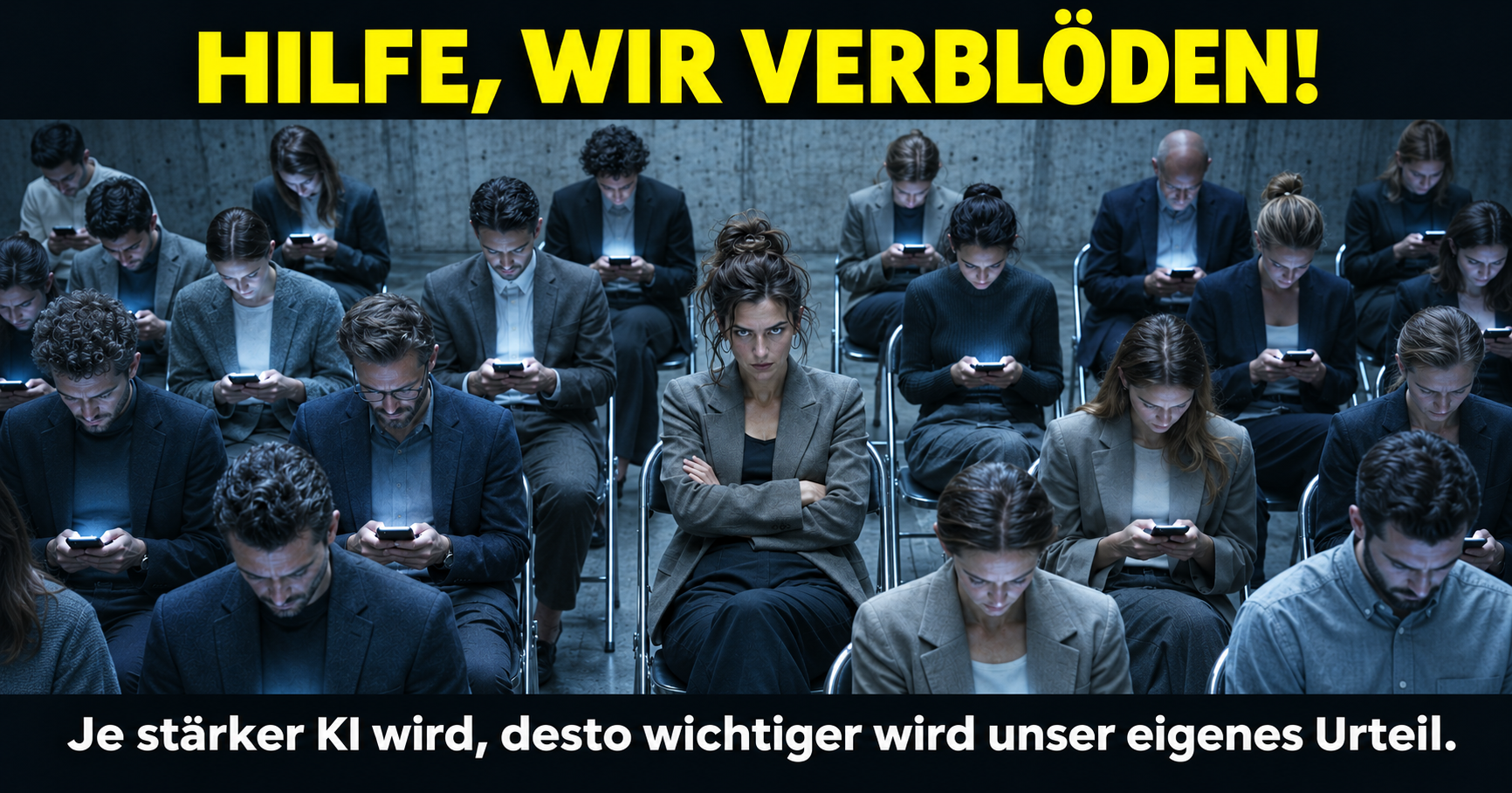
PwC: The more AI becomes advanced, the more important it becomes to think for yourself
PwC US plans to introduce a «Critical Thinking & Judgment Certificate» program for more than 85,000 employees and partners. The launch is scheduled for December 2026; participants are expected to complete the program by June 2027. It is aimed at the US and Mexico locations as well as the associated Acceleration Centers (Umesh, 2026).
What is noteworthy is the focus: It is not simply about formulating better inputs for AI systems. Participants are to learn to systematically assess information, question assumptions, and make comprehensible decisions – especially where AI is being used. Plans include, among other things, a diagnostic entry scenario, practical exercises, and personalized simulations related to the respective professional role (Umesh, 2026).
Important questions arise for one’s own work as a result of this:
- Does the answer actually fit our task?
- What information or perspectives are missing?
- What assumptions are the proposal based on?
- What do we need to check before we continue working?
- Who takes responsibility for the decision?
This gives further education a different direction: It is not blind trust in technology that is at the center, but a conscious approach to it.
Accenture: Not everyone needs to develop AI – but many should understand it
Accenture is expanding its workforce. According to its own data, by August 31, 2025, more than 550,000 employees had completed training on the fundamentals of generative AI (Accenture, et al.).
The AI learning strategy is based on three pillars: «Educate, Enable and Embed». These refer to building knowledge, enabling practical application, and integrating AI into daily work. The offerings are tailored to role and need; in addition, specialized learning paths are available, such as role-based bootcamps (Accenture, etc.).
A professional in recruiting has different responsibilities than someone in accounting, sales, or software development. Therefore, a starting point for a small business is to combine common fundamentals with specific applications in their respective fields of work.
A possible starting point would be to create a draft of a job advertisement and then jointly assess whether the requirements are realistic; is the language understandable; what statements are too general; what doesn’t fit the company?
Microsoft: Learning takes time and the opportunity to try things out
Microsoft describes internal learning programs for technical and non-technical employees, including in marketing, sales, and engineering. Based on these experiences, the company has developed ten approaches for building competencies (Jorgensen, 2025).
These include:
- Provide time and tools for exploration.
- Start with basic knowledge and offer clear learning paths.
- Tailor training to the respective role.
- Provide guidelines for responsible use.
- Promote the exchange of experience among employees.
- Regularly update learning content.
Microsoft has identified specific internal formats for this: practical challenges, workshops, role-based learning paths, and «show-and-tell» events where employees present their projects and findings (Jorgensen, 2025).
For SMEs, it is particularly interesting that not every learning step requires a large course of study. The described approach can, for example, lead to regular exchange of experience within the team: One person demonstrates an application, explains the process, and also discusses what did not work.
What these examples have in common
The programs are not identical. PwC puts the focus on judgment; Accenture combines fundamentals with embedding them in everyday work; and Microsoft emphasizes, among other things, practical learning opportunities and the exchange among employees (Accenture, among others; Jorgensen, 2025; Umesh, 2026).
PwC
Judgement-making at the center
Accenture
Fundamentals and integration into everyday work
Microsoft
Practical learning opportunities and exchange
An important limitation: The programs and figures described demonstrate educational activities. On their own, they are not yet evidence of how much productivity, quality of work, or motivation will increase as a result. Especially the reports from Accenture and Microsoft are proprietary reports from the companies, not independent effectiveness studies.
Nevertheless, the examples are useful as a guide: they show the various components from which companies can develop a suitable learning offering.
Five steps to getting started in the SME sector
From the approaches described, a manageable approach for smaller companies can be derived. It is not a ready-made recipe for success, but rather a proposal for a practical start.
Start with a specific task
Choose a recurring task, such as a customer letter, a meeting summary, or an initial draft of a concept. The task should be clear enough so that the outcome can be evaluated later.
Clarify the basics and game rules
Before trying it out, you need to have some guidance: Which applications are allowed to be used? What data may be used? Who checks the results? Responsible use is explicitly included in the learning content at Microsoft (Jorgensen, 2025).
Appraise quality together
Determine in advance what constitutes a good result. Then, examine not only the wording but also the content, completeness, and suitability for the specific purpose. This focus adopts the approach described by PwC, consciously verifying information and assumptions (Umesh, 2026).
Share experiences
Discusses successful applications as well as unusable results. The exchange formats described by Microsoft can serve as a model, in which employees present their projects and findings (Jorgensen, 2025).
Choose the next learning step appropriate to the role
After the first attempts, not everyone has to follow the same course. It would be useful to align the next learning task with the actual tasks and open questions – in line with the role-based approach of Accenture and Microsoft (Accenture, et al.; Jorgensen, 2025).
Continuing education as an invitation rather than a threat
The communication about this can be consciously designed.
You also have to be able to use AI now.
We take the time to work together to determine where AI can support us and where our own judgment remains necessary.
The second approach makes room for different prior knowledge. It allows for questions and presents the professional task as a tool.
Knowing as many AI applications as possible.
be able to work on a relevant task with a suitable tool and subsequently self-evaluate whether the result is usable.
One's own experience remains the starting point
The examples from PwC, Accenture and Microsoft can be understood as an invitation to think more broadly about AI training: as a combination of fundamental knowledge, practical application and human judgment (Accenture, among others; Jorgensen, 2025; Umesh, 2026).
Therefore, the first step for Swiss SMEs could be smaller than what the big corporate names would suggest:
The scale should not be set by the number of tools used, but by the quality of the work that results from them.
The technology provides suggestions.What we make of it remains our task.
Sources according to APA 7
Accenture. (o. D.). How our people power our business. https://www.accenture.com/en/about/company/integrated-reporting-talent
Jorgensen, J. (2025, January 30). Accelerate employee AI skilling: Insights from Microsoft. The Microsoft Cloud Blog. https://www.microsoft.com/en-us/microsoft-cloud/blog/2025/01/30/accelerate-employee-ai-skilling-insights-from-microsoft/
Umesh, E. (2026, November 10). PwC US to train 85,000 staff in critical thinking as AI reshapes work. International Accounting Bulletin. https://www.internationalaccountingbulletin.com/news/pwc-us-to-train-85000-staff-in-critical-thinking-as-ai-reshapes-work/