24th July 2026 Janine Praxmarer
I have to be honest: When ChatGPT and artificial intelligence suddenly became ubiquitous, I couldn't really understand all the hype.
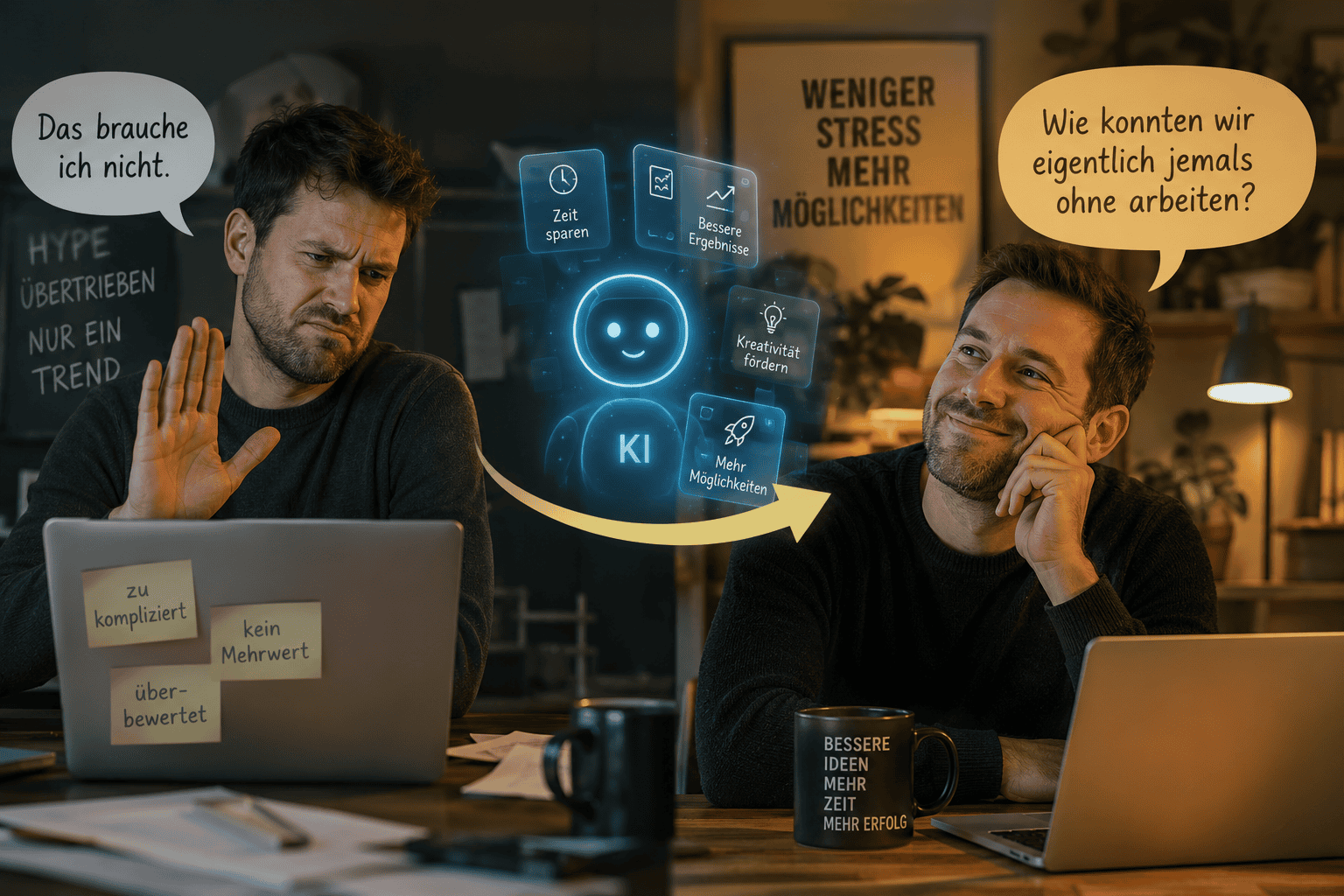
Back then, I was still studying and I could really feel that every person around me was using AI. Whether for homework, summaries, brainstorming sessions, or just to have things explained to me. And I? I was probably the only one who said: „No, I don’t need that.“
Not because I had anything against new technologies. Quite the opposite. I simply really enjoy doing my own research, and I still do it incredibly enthusiastically today. I used Google, read professional articles, compared different sources, and compiled my own information myself. For me, that was completely normal, and to be honest, I even enjoyed it.
„Why should I ask an AI if I can find the answer myself?“
Today I have to laugh a little about myself. Because whether we wanted to or not, we just couldn't help but notice it eventually.
Suddenly, AI was discussed at every meeting. On LinkedIn, there were new posts every day. Companies were asking about AI strategies. Friends and colleagues told me how much time they were saving thanks to it. And eventually, it dawned on me: It’s not even about whether AI is good or bad.
The real question is
How can we use them in a meaningful way?
And that’s exactly where my perspective completely changed. Today, I use artificial intelligence almost daily. But not because I want to make the work easier for myself. But because I realized that AI is not a substitute for my thinking.
I still like to do my own research. I check sources, question content, and form my own opinion. But AI helps me get to my goal faster. It gives me ideas, helps structure ideas, or takes away routine tasks that used to take an incredibly long time.
AI is not meant to replace us.
She is supposed to give us time.
Time for creativity. Time for conversations. Time for innovation.
Time for the things that really make a difference.
Many companies are still uncertain
Unfortunately, I also see that many companies are still uncertain. The development is rapid. It feels like every week a new tool appears. Every day we read about new features, new possibilities, and new promises. It’s easy to lose track of everything.
The ones who are
they are afraid of losing their connection.
The others
They don't even know where to start.
And others again
AI is already being used, but its potential is not being exploited.
That is exactly why I find the idea of AI Hotline so important. Not because companies need more tools. But because they Orientation need.
Someone who clearly explains the possibilities that are actually available. Someone who honestly says what AI is really useful for and what might not be suitable for the company at all. Because AI is not an end in itself and not every company needs to automate everything. At the same time, not every process requires artificial intelligence. But every company should understand the opportunities that AI can offer.
AI and Employer Branding
For me, AI is also very much related to employer branding. Why? Because modern employers should give their employees the opportunity to work smarter, not just more.
When AI takes on repetitive tasks, there is more time left for what humans are truly good at: being creative, building relationships, solving problems, and developing ideas together. This not only makes work more efficient but often also more fulfilling.
It helps companies integrate artificial intelligence into their daily work in a clear, practical and meaningful way. Without complicated technical terms. Without unrealistic promises. Instead, with the goal of creating real added value — for companies and, above all, for the people who work there.
My conclusion
Looking back on my first reaction today, I have to smile. Back then, I thought I didn’t need all that.
It’s not about whether AI will come. It’s already here, anyway. The much more interesting question is how we use it to make our everyday work easier, instead of making it more complicated.
And it is precisely in this area that the AI hotline wants to support companies — understandable, honest and on equal terms.